

DataHex for superannuation and pension funds
Build Data Transparency and Governance into the Foundations
A data inventory platform for superannuation funds and pension plans that starts right-sized and scales as your investment teams grow.
Build Data Transparency and Governance into the Foundations
DataHex Data Library gives funds one transparent inventory of their third-party and internal data, with a tracked DNA, a named owner and access controls on every asset. It is built on a capital markets ontology, onboards data and users quickly, and runs self-managed in your cloud or hosted by RoZetta.
- 01 · TRANSPARENTThird-party and internal data, one inventory
- 02 · RIGHT-SIZEDStart focused, scale as needs grow
- 03 · FLEXIBLESelf-managed or hosted
- 04 · SIGNALSAlpha, risk and benchmarking
The opportunity
Internal investment capability needs a data foundation
Funds in both markets are bringing more investment management in-house and expanding internal quant teams to optimize performance. Every new mandate, model and analyst adds data, and without a system of record, transparency erodes as the estate grows.
Growing internal teams
Internal quant and investment teams need to find, trust and use data quickly, without rebuilding context each time.
Rising data spend
More vendor licenses, alternative data and derived data sets, with limited evidence of what is used.
Accountability to members
Funds are expected to demonstrate how investment data is sourced, governed and used.
Transparency is hard to retrofit
Firms that add governance after their data estate has grown find the gaps hardest to close.
Right-sized, then scaled
Starts where you are, grows with your requirements
Begin with a focused inventory and the governance your team needs today. Add capability as quant teams expand and requirements become more complex, on the same platform and without a migration.
Inventory
A transparent library of third-party and internal data sets, with owners, descriptions and license terms.
Govern
Lineage, quality tests, data contracts, classification and role-based access across the estate.
Enable quants
Capital markets search, previews, one-click launch into notebooks and backtesting, and governed AI agents.
Extend
Investment signal tools, in-catalog analytics and MCP access for every internal and third-party AI client.
Short and long-term benefits
Value in the short term, and for years after
The early benefits are practical: a clear view of the data you hold and faster access to it. The long-term benefits compound as the discipline becomes part of how the fund operates.
In the short term
Clarity and speed
- A single, transparent view of third-party and internal data
- Named owners and access controls on every data asset
- Usage evidence on licensed data ahead of the next renewal
- Self-service access that replaces ticket queues
- New staff oriented through the data inventory with role-based permissions
Over the years
A compounding advantage
- Institutional knowledge that stays when people leave
- A governed foundation that expanded quant teams build on
- Defensible data spend as the estate grows
- Audit-ready provenance for regulators, boards and members
- AI adoption inside the same controls as people
Data asset DNA
Define and track the DNA of every data asset
A living knowledge graph connects every asset, column, owner, glossary term, classification, quality signal, lineage edge, policy and contract. Exposed through Model Context Protocol, the same DNA is available to people and AI agents.
01Meaning and classification
- Business-first name, description and glossary terms, so every team uses the same definition
- Classification against your taxonomy and sensitivity levels: public, internal, confidential, restricted
- Custom taxonomy per tenant, shipped as version-controllable YAML
02Origin and lineage
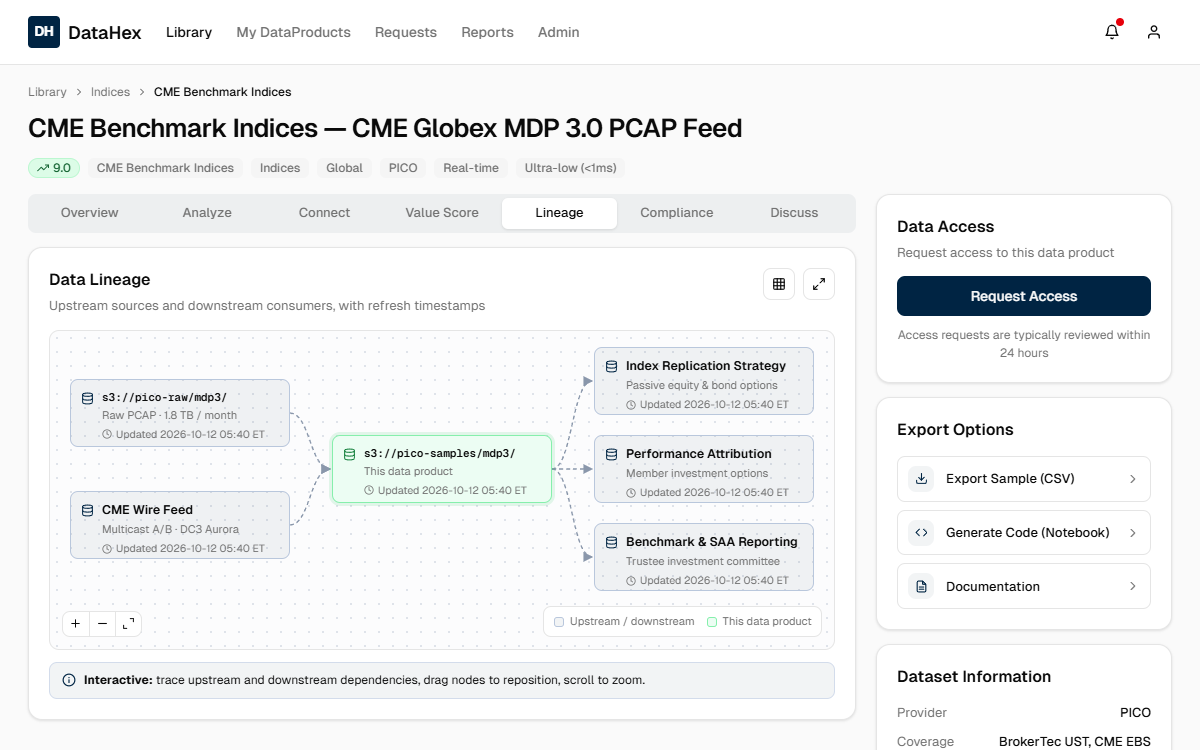
- Automated table, column, pipeline, dashboard and ML-model lineage from SQL, dbt, Airflow and Spark, with OpenLineage ingestion
- Column-level lineage traced from query logic, so the impact of a schema change is exact
- Impact analysis: change a source and see every downstream consumer it touches
03Quality and data contracts
- Metrics for completeness, freshness, schema stability, primary-key uniqueness and downstream usage
- Scheduled freshness, volume and integrity tests with alerting, and business-rule validation tuned for financial data
- A data contract on every product: expected schema, required semantics, assigned quality tests and execution history
04Licensing and usage
- Vendor licensing, redistribution rights and per-user entitlements modeled as first-class objects
- The Compliance Agent extracts entitlement, redistribution and retention terms from license agreements and tracks renewals
- Most-used and under-used assets, and failed searches that signal unmet demand
Ownership and access
Clear accountability, controlled access
Products are organized into governed domains, by asset class, portfolio or team, each with clear ownership. Policies are defined once and enforced across the catalog, data stores and agentic access.
Named owners
Each product has explicit owners on its detail page, visible to everyone who finds it.
Stewards approve access
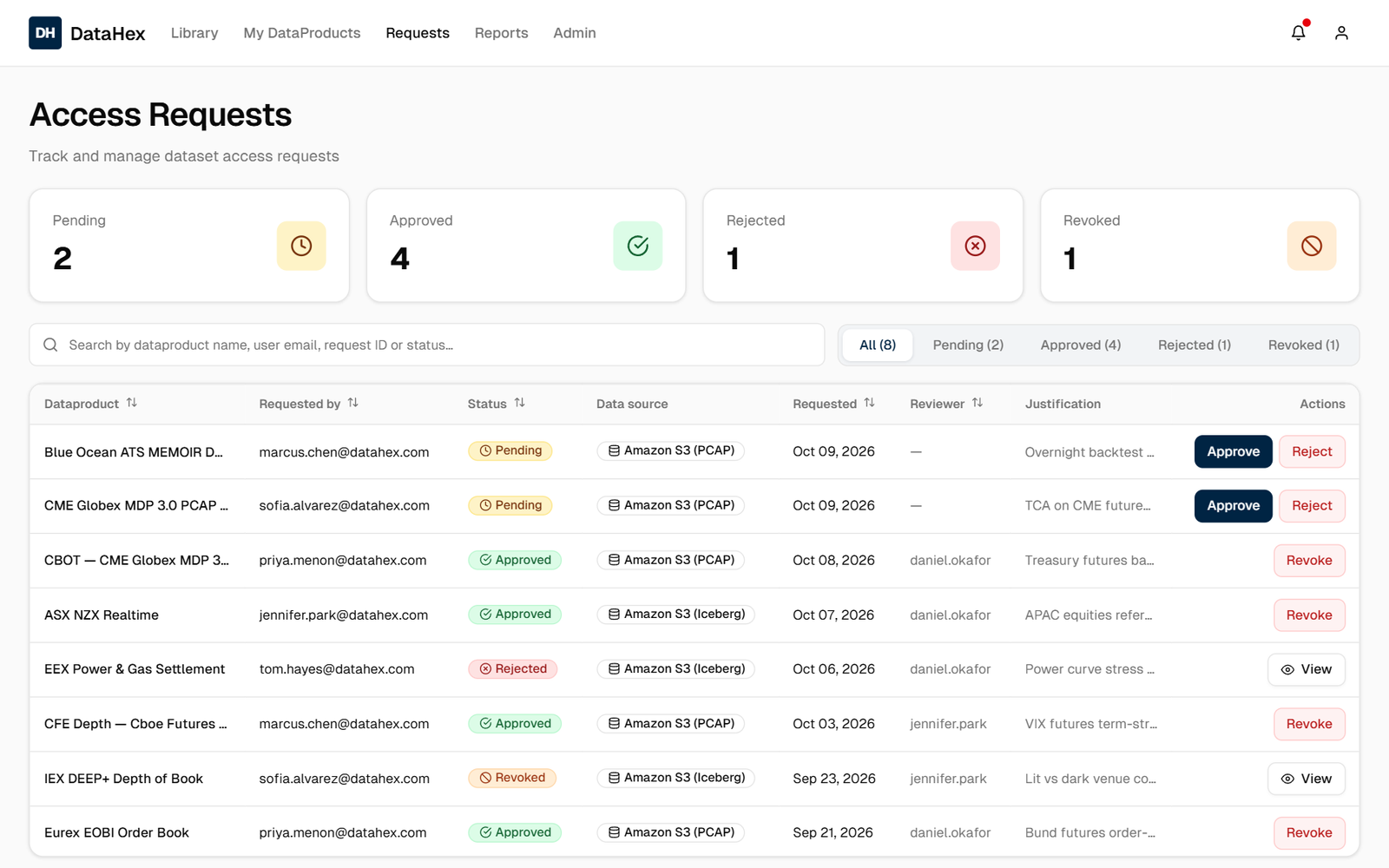
Stewards approve requests for the products they own; admins hold platform-wide override, so approvals do not bottleneck.
Fine-grained controls
Access scoped to product, table, partition and row level, enforced for people and AI agents alike.
Approval workflows
Multi-step and configurable, with justification captured and permissions synced to the source of truth.
Masking and classification
Policy-driven masking protects sensitive fields, and classification travels through lineage and delivery.
Complete audit trail
Every user operation and data-access event recorded, with compliance reporting on the same substrate.

Operational resilience
Data governance that supports CPS 230
CPS 230 sets mandatory minimum requirements for APRA-regulated entities, including RSE licensees, to manage operational risk, maintain business continuity and manage service provider arrangements. Each of these depends on knowing what data the fund relies on, where it comes from, who is accountable for it and who can access it. DataHex Data Library provides that record.
Data lineage
Lineage and metadata on every data product show where data comes from and which processes depend on it, giving you a living record for your critical operations maps.
Data quality
Quality indicators, ownership and usage history sit with every data product, so teams know the data behind critical operations is fit for use, and can check it quickly if a disruption occurs.
Data classification
Classification, licensing terms and access policies are recorded against every data product, showing which data comes from material service providers, who relies on it and who can access it, with a full audit trail.
Capital markets ontology
Built for investment data from day one
DataHex embeds reference data for instruments, including security master and instrument identifiers, directly into the knowledge graph. Instruments, issuers, venues, asset classes and corporate-actions relationships are modeled as connected entities.
Market-aware taxonomy
Venue, asset-class and instrument-aware facets, with hierarchies such as Asset Class → Equities → Single-stock options.
Tuned semantic search
Embeddings tuned for venues, instruments, asset classes, vendor terms and regulatory acronyms.
Data resolves to shared identifiers
Every data set resolves to the entities it references, so vendor, custodian and internal data link on the same identifiers.
Open and portable
Relationships are expressible as RDF and ontology through metadata APIs, so your model stays interoperable.
Speed to onboard
Data and users onboarded quickly
In our experience funds reach a populated, governed catalog early in the phased implementation process, enabling new team members to be productive much sooner in the Library.
- 01
Agent-assisted data onboarding
The Governance Agent drafts a data product from a connection or sample file. What can take a day per data set takes minutes.
- 02
Broad connectivity
130+ out-of-the-box connectors, plus market-data connectors for tick feeds, security master, corporate actions and vendor services.
- 03
Bulk onboarding
Dozens of products stood up from curated specs, such as a markdown one-pager or YAML spec.
- 04
User onboarding by role
New analysts and quants receive permissions matched to their role, and see the full data inventory from day one.
Deployment & integration
Your data stays in your own environment
DataHex connects to where your data already lives and deploys on your terms, as a managed SaaS service or inside your own infrastructure. No migration, no forced copy, no new silo. Your data stays where it lives and the knowledge your teams capture remains yours.
Choose your deployment model
Run DataHex as a fully managed SaaS service and be up and running fast, or deploy it into your own cloud or on-premises environment for full control.
130+ connectors
Databases, warehouses and lakes, BI, pipelines including dbt, Airflow and Spark, ML platforms, messaging and object storage.
Market-data native
Tick feeds, security master, reference data, corporate actions, and protocol-aware order-book decoding.
No forced copy
Your data stays where it is, whether that’s a data warehouse or data lake, in the cloud or on-premises.

Investment signal tools
Alpha discovery, risk assessment and benchmarking
Signal tools that run on the same governed foundation give internal investment teams more ways to use the data they hold.
DataHex Thematic Studio
Thematic investment signals for identifying exposure to structural themes, supporting alpha discovery and portfolio construction.
Explore DataHex Thematic StudioCISSA Economic Lens
Economic-performance signals for assessing company quality and risk, and benchmarking holdings and managers.
Explore CISSA Economic LensA foundational discipline
Set up transparency before complexity arrives
Investment firms that setup governance after their data estate had grown acknowledge data transparency remains one of their most significant challenges. Funds that establish a Data Library discipline upfront build every new team, mandate and model on a governed foundation.
| As the estate grows | Governance added later | Data Library as foundation |
|---|---|---|
| Inventory | Assembled after the fact from spreadsheets and interviews | Complete from the start, and kept current as data is added |
| Ownership | Unclear, and reconstructed when something breaks | Named on every product from the day it is onboarded |
| Lineage | Partial, and missing for older data sets | Recorded automatically as pipelines are built |
| Licensing spend | Renewals decided on limited evidence | Usage tracked against every license |
| New quant teams | Rediscover data and rebuild context | Start from a governed, documented inventory |
| AI adoption | Agents operate outside existing controls | Agents inherit the same entitlements and audit as people |

See a right-sized Data Library for your fund
A walkthrough tailored to your use case, investment teams and preferred deployment model.