

Data catalog and governance · engineered for financial institutions
In the AI Era, Every Organization Runs on Governed Data
AI agents are only as reliable as the data they can find, understand and are permitted to use. DataHex catalogs and governs that data within the workflow, for humans and AI agents alike.
In the AI Era, Every Organization Runs on Governed Data
A market-data feed carries vendor entitlements, redistribution limits, venue and instrument context, and an audit obligation. Every DataHex product treats those as first-class governance objects, engineered around the instruments, venues, protocols and regulatory realities financial institutions work with every day.
- 01 · ENTITLEMENTSLicense terms enforced at delivery
- 02 · PROVENANCELineage and quality before extraction
- 03 · AUDITOne substrate, evidence from source
- 04 · AI GOVERNANCEAgents inside the same boundary

The governance stack
Eight governance capabilities, built into every data product
Data quality, lineage, ownership, access, classification and audit are first-class surfaces visible at the point of evaluation, not a governance program running beside the platform.
Lineage
Automated table, column, pipeline, dashboard and ML-model lineage from SQL, dbt, Airflow and Spark, with OpenLineage ingestion and an interactive impact-analysis graph.
Quality and trust
Profiling, anomaly detection and SQL-defined freshness, volume and integrity tests on a schedule, with business-rule validation tuned for financial data and alerting.
Access control
Role-based and attribute-based control scoped to product, table, partition and row level, with multi-step in-UI approval carrying justification, and permissions synced to the source of truth.
Sensitive data and classification
Automated classification against the firm's taxonomy and sensitivity levels, with policy-driven masking and redaction carried through lineage and delivery.
Data contracts
Expected schema, required semantics and assigned quality tests, with execution history, so upstream changes surface as contract breaks rather than silent drift.
Policy management
Licensing, retention, access and data-handling rules defined once, versioned, auditable, and enforced uniformly across the catalog, the data stores and agentic access.
Audit and usage
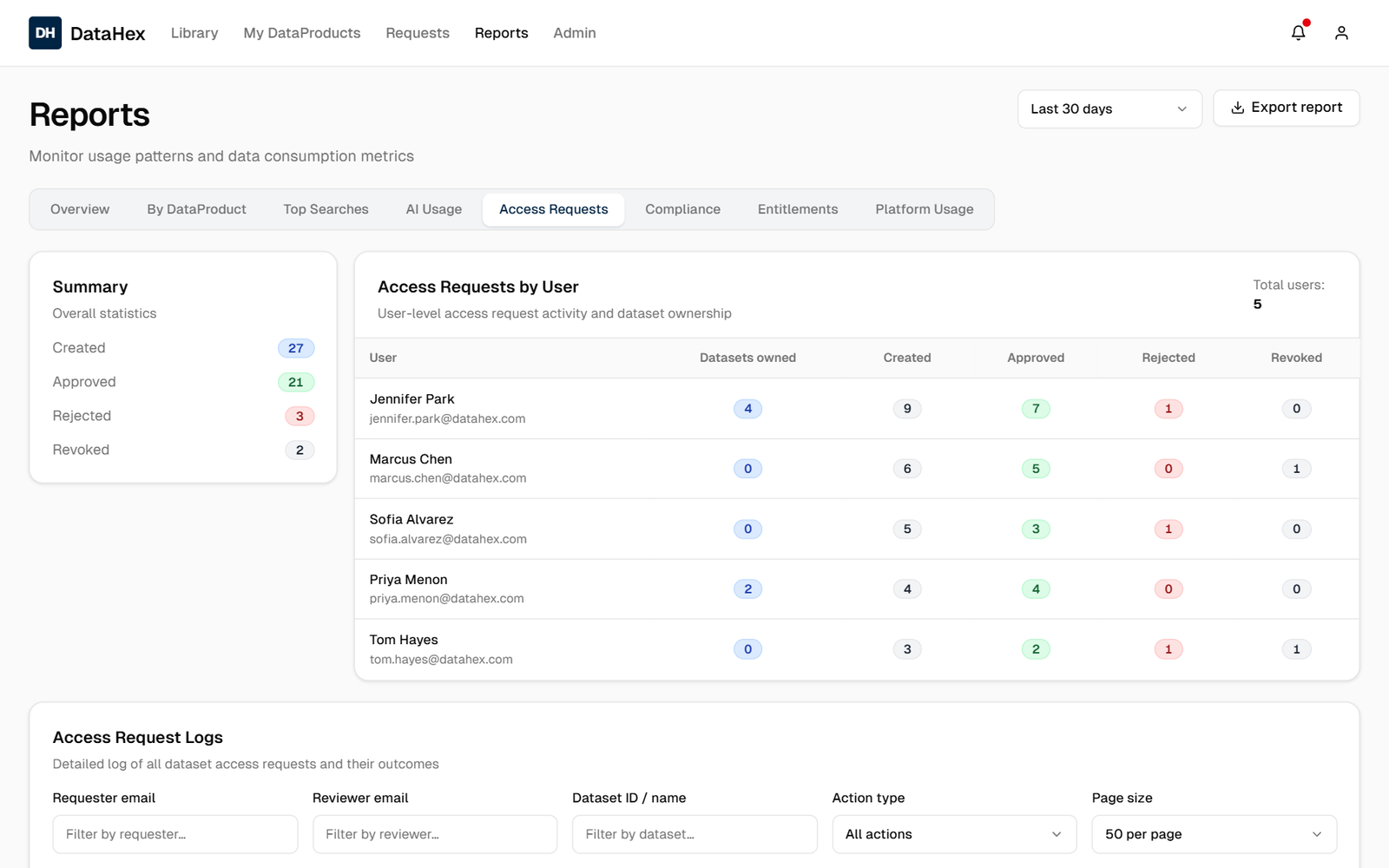
Every user operation and data-access event recorded, with separate streams for search behavior, including failed searches that signal unmet demand, plus time-to-approval and utilization signals.
Ownership and glossary
Explicit owners on every product, and a central glossary and hierarchical taxonomy, so a filter on “investment-grade credit” means the same thing to every producer and consumer.
The data catalog
Governance that people and AI agents can leverage to scale
Governance pays off when data is discoverable with confidence. DataHex Data Library is the catalog layer where every governed data product is found, evaluated and consumed, landing users on a library view rather than an admin console.
Find it fast
Hybrid search tuned for capital markets
Exact, fuzzy and semantic ranking on embeddings tuned for venues, instruments, asset classes, vendor terms and regulatory acronyms.
Plain-language discovery
Queries such as “data for backtesting VIX volatility” land on the right data sets, even when the language differs from the schema.
Custom taxonomy per organization
Each organization defines its own facets and hierarchies, shipped as version-controllable YAML. The taxonomy is configuration, not code.
Trust it before use
Business-first data products
Data organized as governed data products for business users, with a hierarchical taxonomy, business domains and 360° asset pages.
Previews in place
Sample data, parsed previews and in-content search sit inside the data-product page, so users judge fit before requesting access.
Knowledge graph and security master
Every asset, column, owner, term, policy and contract in one graph, with instrument reference data embedded so data sets resolve to the instruments they reference.
Use it with shared context
Collaboration on the asset
Engineer’s notes, threaded discussions, stewardship tasks, activity feeds and announcements live on the asset page, so tribal knowledge becomes shared, institutional knowledge.
In-catalog analytics
Ask in plain language and get a governed chart or dashboard back, inside the catalog, under the same entitlements and audit.
One-click consumption
Launch into BI, backtesting and notebooks, with code-snippet generation, scheduled extractions, and delivery by API, SFTP, S3 and email.
Market-data entitlements
A compliance layer engineered for market-data licensing
Vendor licensing, redistribution rights and per-user entitlements are modeled as first-class governance objects, instruments, volume, venues, history, so the platform enforces what each user and each agent is actually licensed to see.
Enforced at the point of delivery
Display, non-display and redistribution rights are applied when data moves, not tracked in a spreadsheet afterwards. Subscription, entitlement and quota management run at user, application, department and company level.
Traced back to the clause
Embedded legal AI reads license agreements and data contracts, extracts entitlement, redistribution and retention terms, and tracks obligations, renewals and breach conditions, so an enforced rule traces back to the clause that created it.
Evidenced both ways
Usage reporting gives the seller vendor reporting and license reconciliation, and the buyer market-data cost recovery, with duplication across vendor contracts surfaced before the renewal conversation.
Self-service without exposure
Access flows run against the entitlement framework rather than a ticket queue, so a desk moves quickly while the licensing boundary stays intact.
Regulatory & compliance coverage
What compliance, risk and audit teams are accountable for
Grounded in the same governance surfaces the desk already uses, so evidence is produced from source rather than reconstructed.
Provenance for risk-data aggregation
End-to-end lineage and a complete audit trail provide what principles-based regimes such as BCBS 239 expect: where data originated, how it was transformed, who accessed it, and when.
Market-data licensing compliance
Entitlement enforcement and usage auditing demonstrate that vendor market-data is consumed and redistributed within licensed terms, evidence for a recurring audit obligation, produced from the platform itself.
Audit-ready reporting
Compliance reporting, search-behavior signals and security-event monitoring run on a single audit substrate, so evidence for internal audit and regulators comes from source.
Data residency and sovereignty
Storage stays in the region the firm already operates in, and every read and write is scoped by organization at the middleware layer, supporting jurisdictional data-residency obligations.
Obligations tracked, not filed
Interpreted license terms feed the enforcement engine, with renewal and breach conditions tracked, so the rules the platform applies stay tied to the agreements behind them.
A defensible record of AI access
Because agents access data through the same framework as human users, every agent action inherits lineage, quality, licensing and audit context, a record of what data an AI used and under what authority.
Point of differentiation
Built for the questions a market-data audit asks
A market-data audit asks a specific set of questions: which instruments is this user licensed to see, on which venues, over what history, through which application, and can you prove it. DataHex is built to answer each one from the platform itself.
| The governance question | What financial institutions require | How DataHex delivers it |
|---|---|---|
| Who is licensed to see this? | Proof that each user and application sees only what the firm is licensed to distribute | An entitlement engine modeling instruments, volume, venues and history, enforced at the point of delivery |
| What does the contract actually say? | License terms available to the platform that has to enforce them | The Compliance Agent reads licenses and data contracts, extracts entitlement, redistribution and retention terms, and feeds the enforcement engine |
| What is this dataset, in market terms? | Datasets described in instruments, issuers and venues | Security master and instrument identifiers in the graph, so a dataset resolves to the instruments, issuers and venues it references |
| Can we prove who used what? | A defensible record of every access, by user and application | A complete audit trail of every operation and access event at application, user, department and company level, on one substrate |
| Is the data fit to trade on? | Assurance the data is fit for a trading or research decision | Completeness, freshness, schema stability and key-uniqueness tests on a schedule, with business-rule validation tuned for financial data |
| What breaks if a source changes? | Advance warning of what a source change will affect downstream | Column-level lineage with impact analysis, and data contracts that surface a break before it reaches a decision |
| Under whose authority did the AI act? | AI activity held to the same authority as a person’s | MCP-native access: every agent inherits the same entitlements, lineage, classification, policy and audit as a human user |

Want to discuss your data governance challenges
A walkthrough tailored to your use case, covering entitlements, lineage requirements and the evidence your audit function has to produce.