

DataHex for hedge funds, asset managers and banks
Know Every Data Asset Your Firm Holds
One governed library for your third-party and internally built data, deployed in your own cloud.
Know Every Data Asset Your Firm Holds
DataHex Data Library records the DNA of every data asset: what it is, where it came from, who owns it, who may use it and how it is used. It connects that inventory to your analytics workspaces and AI agents, with a capital markets ontology and security master built in.
- 01 · INVENTORYThird-party and internal, in one library
- 02 · DNATracked on every data asset
- 03 · DEPLOYMENTIn your own cloud account
- 04 · LICENSINGUsage tracked against spend
The challenge
Data estates in the thousands need a system of record
Funds and banks license hundreds of vendor feeds and build thousands of derived data sets on top of them. As the estate grows, knowing what each asset is, who owns it and whether it is used becomes the difference between an edge and an expense.
Licensing is a large and growing cost
Market data licensing is one of the largest line items in any data budget, and renewals are often decided without usage evidence.
Internal assets go undocumented
Research data sets, signals and derived tables are built by individuals and rarely cataloged with their lineage or intent.
Knowledge leaves with people
When an analyst or engineer moves on, the context behind the data they built goes with them.
New staff start from zero
New joiners spend their first weeks finding out what data exists, what it means and how to get access.
One inventory
Third-party and internally built data products, governed together
Discover and evaluate data products across vendor, internal and alternative sources from a single library view. Data quality, lineage, ownership, access and audit are first-class surfaces on every data product.
Third-party data
Vendor feeds, reference data and alternative data sets cataloged with their license terms, entitlements and redistribution rights.
Internally built assets
Research data sets, derived signals, models and dashboards published as governed data products with named owners.
Business-first discovery
Hybrid semantic, fuzzy and exact search tuned for capital markets vocabulary, so a query like “data for backtesting VIX volatility” lands on the right data set.
Previews in place
Sample data, parsed previews and in-catalog analytics let users judge fit before requesting access.
A profile that never changes
The DNA of every data asset
Every data asset carries a complete, machine-readable profile, held in a living knowledge graph and exposed through built-in Model Context Protocol. People and AI agents read the same DNA: what the data means, where it came from, who owns it, how it is used and whether it can be trusted.
Like DNA, the profile stays bound to the asset wherever and however it is used, by any desk, tool or agent. As estates grow into the thousands of data sets, this record is what keeps them usable.
01Meaning
- Business-first name, description and semantic-layer definitions
- Terms from a central glossary and hierarchical taxonomy, so every desk uses the same definition
- Classification against your taxonomy and sensitivity levels: public, internal, confidential, restricted
02Origin and lineage
- Automated table, column, pipeline, dashboard and ML-model lineage from SQL, dbt, Airflow and Spark, with OpenLineage ingestion
- Column-level lineage traced from query logic, so the impact of a schema change is exact
- Impact analysis: change a source and see every downstream consumer it touches
03Ownership and contract
- Explicit owners and stewards on the product page
- A data contract over each product: expected schema, required semantics, assigned quality tests and execution history
- Upstream changes surface as contract breaks before they reach a decision
04Quality and trust
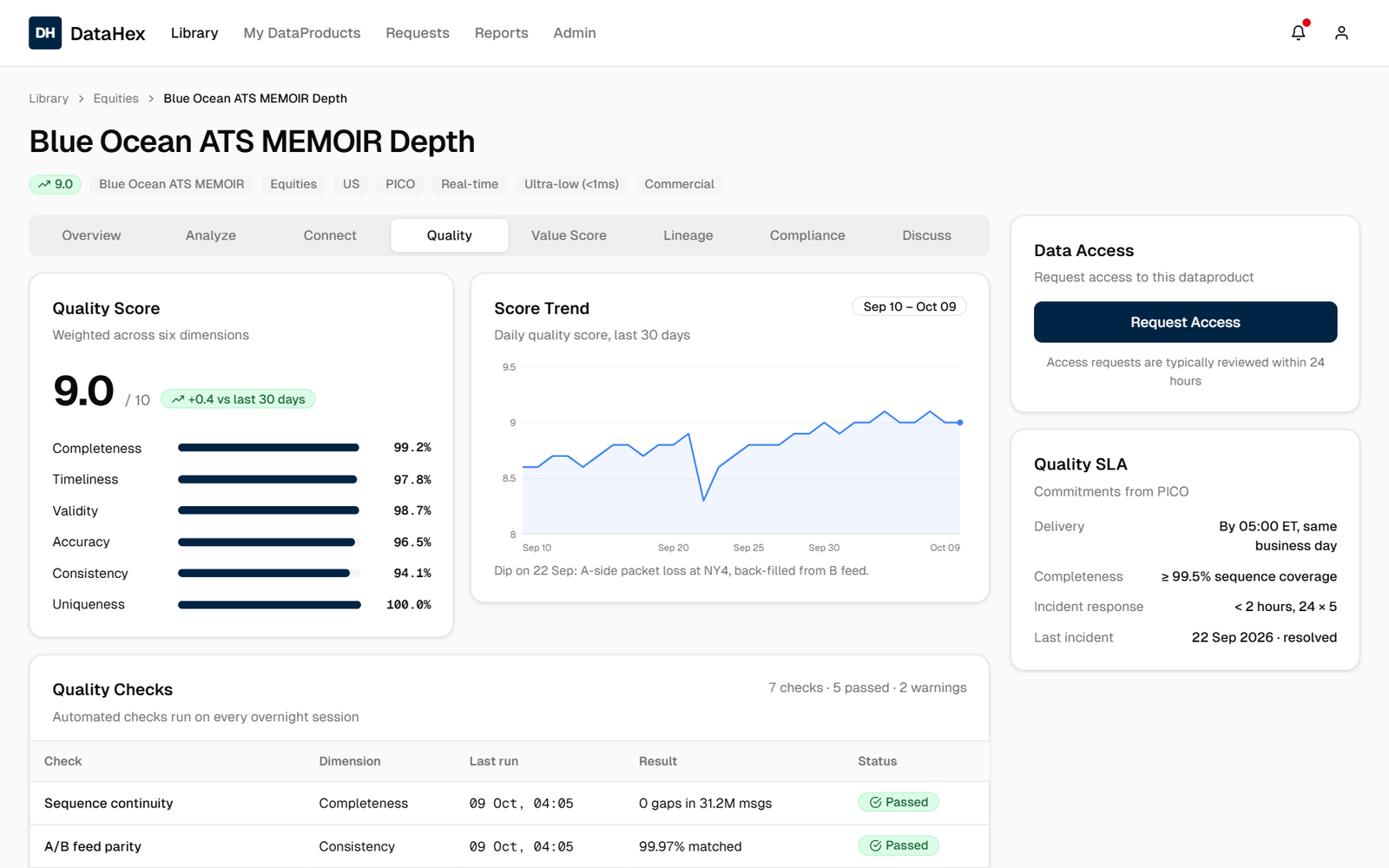
- Metrics for completeness, freshness, schema stability, primary-key uniqueness and downstream usage
- Profiles with null counts, distinct values, distribution shape and anomaly flags
- Scheduled freshness, volume and integrity tests with alerting, and business-rule validation tuned for financial data
05Licensing and access
- Vendor licensing, redistribution rights and per-user entitlements modeled as first-class objects: instruments, volume, venues, history
- The Compliance Agent extracts entitlement, redistribution and retention terms from license agreements and data contracts
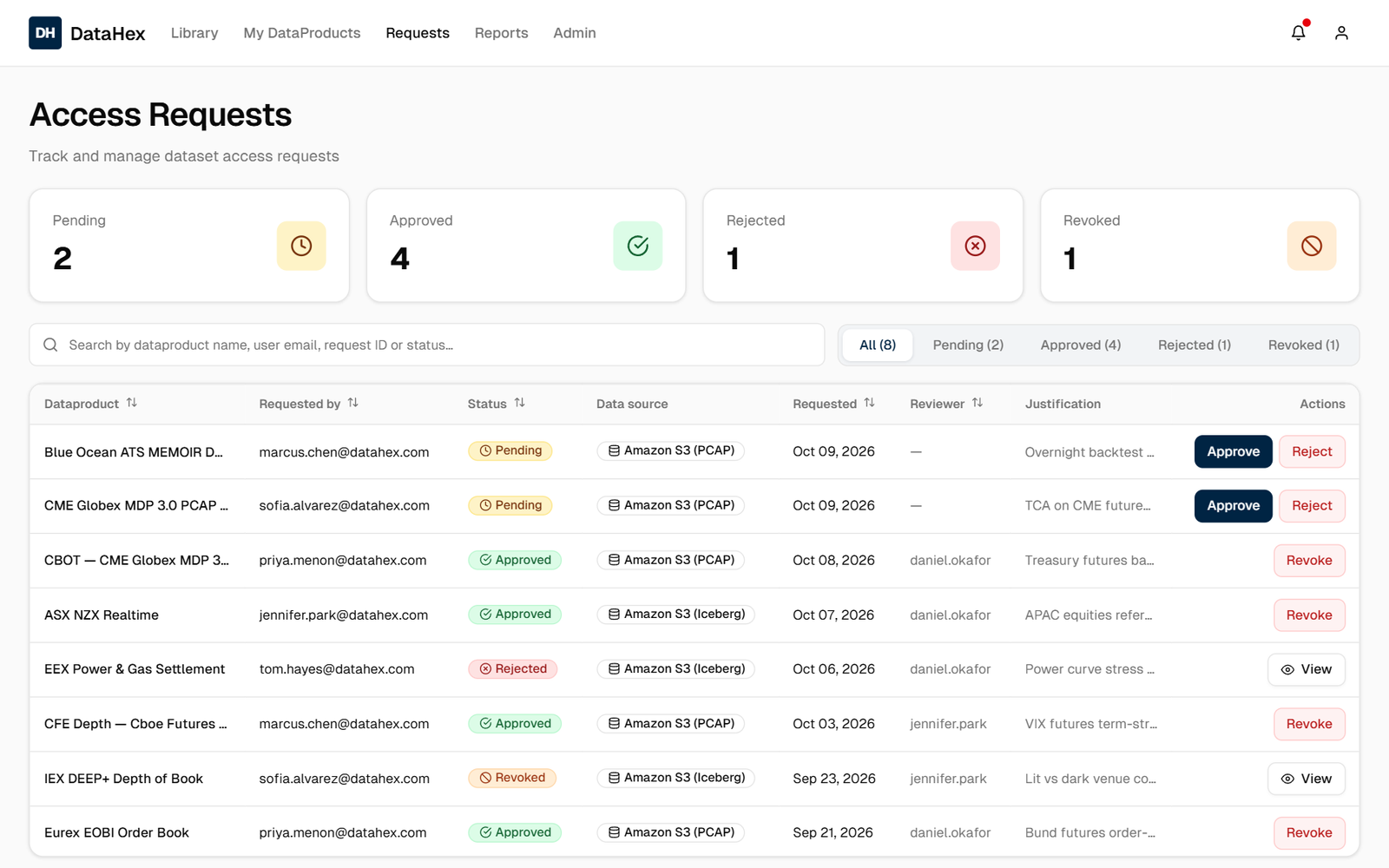
- Who has access, under which role, and who approved it
06Usage
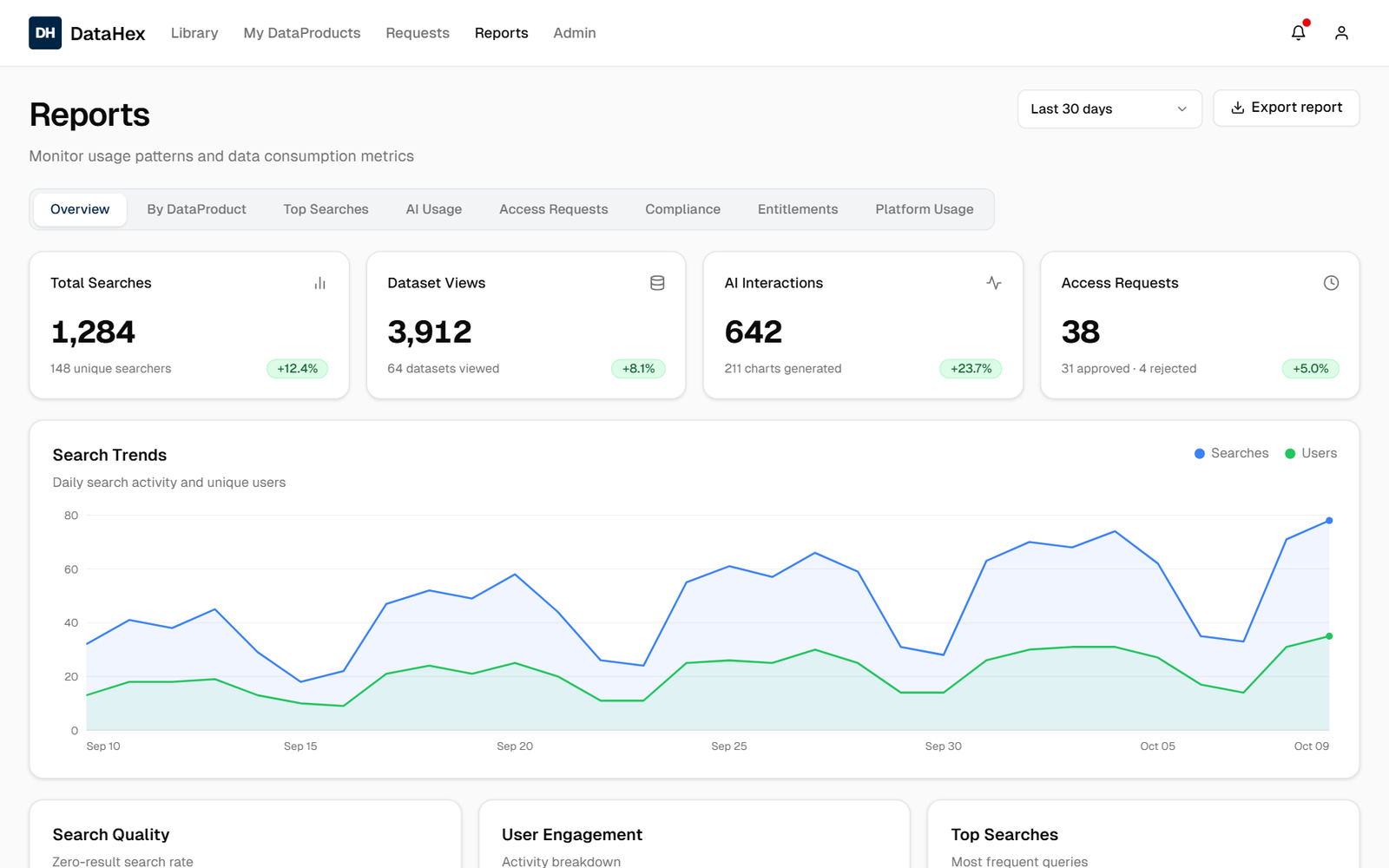
- Most-used and under-used assets, and time-to-approval
- Failed searches that signal unmet demand
- A complete audit trail of every user operation and data-access event, human or agent
Capital markets ontology
Security master and ontology, built in
DataHex embeds reference data for instruments, including security master and instrument identifiers, directly into the knowledge graph. Instruments, issuers, venues, asset classes and corporate-actions relationships are modeled as connected entities.
Data resolves to instruments
A data set resolves to the actual instruments it references, not just column names, so vendor and internal data link on the same identifiers.
Market-aware taxonomy
Venue, asset-class and instrument-aware facets, with hierarchies such as Asset Class → Equities → Single-stock options.
Tuned semantic search
Embeddings tuned for venues, instruments, asset classes, vendor terms and regulatory acronyms ground both people and agents.
Open and portable
Relationships are expressible as RDF and ontology through metadata APIs, so your semantic model stays interoperable.
Federated ownership
Clear accountability for every data product
Products are organized into governed business domains, by desk, asset class or business unit, each with clear ownership. Business domains publish and own their products while definitions, lineage and policy stay governed in one central layer.
Named owners
Each product has explicit owners on its detail page, visible to everyone who finds it.
Stewards approve access
Stewards approve access requests for the products they own; admins hold platform-wide override, so approvals do not bottleneck on one team.
Stewards review, not author
The Governance Agent drafts each data product, including taxonomy, schema, license terms, lineage hints and quality dimensions, for the steward to approve.
Collaboration on the asset
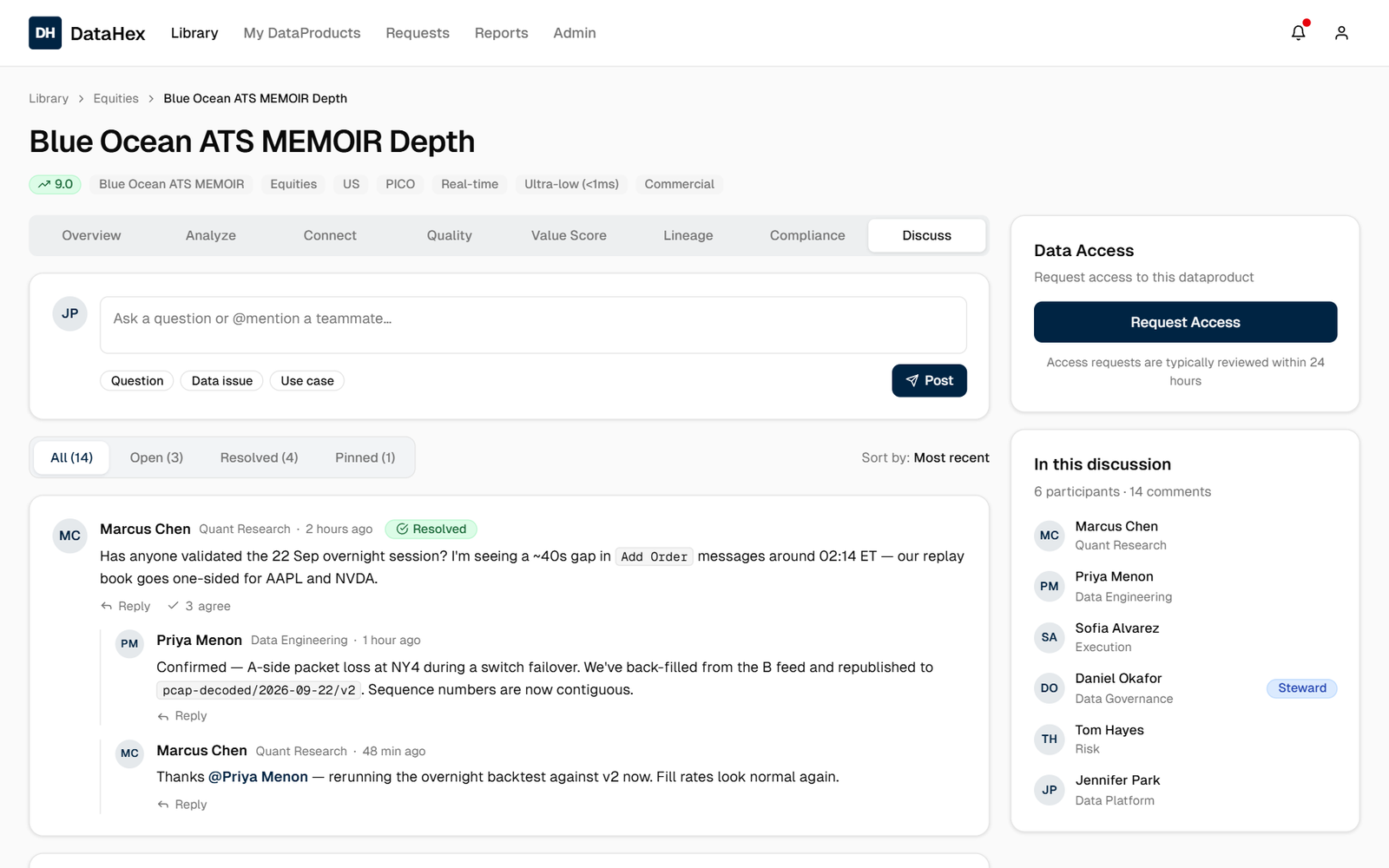
Engineer’s notes, threaded discussions, stewardship tasks and activity feeds live on the asset page.
Library to workspace
Connected to the analytic workspaces your teams already use
The Library sits next to the data, wherever it already lives, with no forced data copy. Users move from discovery to analysis without leaving governance behind.
One-click launch
Launch into BI, backtesting and notebooks, with code-snippet generation for the data product.
In-catalog analytics
Queries and visuals run against governed data inside the catalog, under the same entitlements, classification and audit.
Ask DataHex
The Analyst Agent turns plain-language questions into governed SQL, charts and one-prompt dashboards, within the user’s entitlements.
Delivery on your terms
API, SFTP, cloud storage on AWS, Azure or GCP, email delivery and scheduled extractions.
Lakehouse-native
First-class support for open table formats, with no proprietary lock-in.
MCP for AI agents
Any MCP-compatible client reaches the Library through the same discovery, governance and access-control framework as people.
Internal access control
Access enforced the same way for people and agents
Licensing, retention, access and data-handling policies are defined once, versioned, auditable and enforced uniformly across the catalog, data stores and agentic access.
Role-based access
Customizable roles, such as Consumer, Steward and Admin, scoped per tenant.
Fine-grained controls
Access scoped to product, table, partition and row level, enforced for humans and agents alike.
Approval workflows
Multi-step and configurable. In-UI requests carry justification and partition-range context, with permissions synced to the source of truth.
Masking and redaction
Policy-driven masking protects sensitive fields, and classification travels through lineage and delivery.
Complete audit trail
Every user operation and data-access event recorded, with compliance reporting and security-event monitoring on the same substrate.
Governed AI
Every agent inherits the same entitlements, lineage, classification, policy and audit as a human user.

Onboarding new staff
New joiners productive in days, not weeks
Give new staff access to the Library with permissions matched to their role. They orient themselves through the firm’s full data inventory on day one, see what they can use now, and request the rest through the same workflow.
See the whole estate
Browse every data product the firm holds, including descriptions, owners and quality, even before access is granted to the data itself.
Access matched to role
Permissions follow the role, so a new analyst, quant or portfolio manager starts with the right entitlements.
Context, not just tables
Glossary terms, analyst notes and past questions explain how each data set is used at the firm.
Self-service requests
Entitlement-based self-service replaces ticket queues, so data teams spend less time brokering access.
Corporate IP
Institutional knowledge that stays with the firm
Analyst questions, steward decisions, definitions and corrections accumulate in the knowledge graph as reusable institutional knowledge. Context compounds over time instead of leaving with the people who held it.
Captured as work happens
Usage patterns, analyst notes and context are recorded on the asset, so tribal knowledge becomes institutional intelligence.
Memory that builds
The Analyst Agent turns repeated questions into reusable knowledge for the next person who asks.
Owned by the firm
Open table formats, YAML-portable taxonomy and full metadata APIs keep your governance configuration and data yours.
Market data licensing
Optimize your data inventory with usage evidence
Market data licensing is one of the largest and fastest-growing costs for every firm. The Library tracks access and usage across people and agents, so every renewal is decided on evidence.
See what is used
Usage signals surface most-used and under-used assets, by user, team and application.
Find overlap
Assets linked to the same instruments through the security master reveal where licensed data sets duplicate each other.
Stay within terms
Entitlement enforcement and usage auditing show that vendor data is consumed and redistributed within licensed terms.
Track obligations
The Compliance Agent tracks license obligations, renewal dates and breach conditions from the contracts themselves.
Licensing ROI
Licensing ROI dashboards and internal chargeback allocate cost to the desks that use the data.
Spot unmet demand
Failed searches show what users look for and cannot find, before a new license is signed.
Deployment & integration
Your data stays in your own environment
DataHex connects to where your data already lives and deploys on your terms, as a managed SaaS service or inside your own infrastructure. No migration, no forced copy, no new silo. Your data stays where it lives and the knowledge your teams capture remains yours.
Choose your deployment model
Run DataHex as a fully managed SaaS service and be up and running fast, or deploy it into your own cloud or on-premises environment for full control.
130+ connectors
Databases, warehouses and lakes, BI, pipelines including dbt, Airflow and Spark, ML platforms, messaging and object storage.
Market-data native
Tick feeds, security master, reference data, corporate actions, and protocol-aware order-book decoding.
No forced copy
Your data stays where it is, whether that’s a data warehouse or data lake, in the cloud or on-premises.
Speed to set up
Live in weeks, then migrate at your own pace
Firms reach a populated, governed catalog early, not after a multi-month rollout. Start with the data sets that matter most and bring the rest across gradually.
Connect
130+ out-of-the-box connectors plus purpose-built market-data connectors for tick feeds, security master, corporate actions and vendor services.
Onboard priority data
The Governance Agent drafts a data product from a connection or sample file. What can take a day per data set takes minutes.
Scale in bulk
Scripted onboarding stands up dozens of products from curated specs, such as a markdown one-pager or YAML spec.
Migrate gradually
Switching a source is a metadata change, not a schema migration, so legacy catalogs and spreadsheets retire on your timeline.
Who it serves
Built for every team that depends on data
| Team | What they need | How DataHex delivers it |
|---|---|---|
| Portfolio managers and CIOs | Trust in the data behind a decision | Lineage, quality and licensing context on every data product |
| Quants and analysts | Faster discovery and evaluation | Capital markets search, previews and one-click launch into notebooks and backtesting |
| Chief data officers | A complete, governed inventory | Third-party and internal assets with owners, contracts and usage in one library |
| Market data and procurement | Defensible licensing spend | Usage by asset, team and application, with obligations tracked from contracts |
| Compliance, risk and audit | Evidence without reconstruction | A single audit substrate for access, usage and AI activity |
| Data engineering | Fewer tickets and fewer tools | Automated lineage, self-service access and agent-assisted onboarding |

See how your data inventory can be governed, owned and in use
A walkthrough tailored to your use case, vendor data landscape and cloud environment.