
DataHex for corporates
Know the DNA of Every Data Asset You Own
Capital markets-grade data governance for every data-intensive business, from financial institutions to energy, utilities, telecoms, payments etc.
Know the DNA of Every Data Asset You Own
DataHex Data Library turns your internal data into clearly defined data products, each with a tracked DNA, a named owner and access controls, so your teams and AI agents can use it consistently across the company. It was built for the most demanding data in the world, capital markets data, and applies that discipline to any data your business runs on.
- 01 · ANY DATAStructured, unstructured, sensor, behavioral
- 02 · DNATracked on every data asset
- 03 · AI-READYMCP-native, governed agents
- 04 · CONTROLOwnership and access built in
The challenge
Data is now a core business asset, but rarely managed like one
Operational, customer, sensor and transaction data drive decisions across the business. Without a record of what each data asset is and who is accountable for it, the value is hard to see, harder to protect, and difficult to hand to AI.
No single inventory
Data sits across operational systems, data lakes and spreadsheets, with no shared view of what the company holds.
Unclear accountability
When no one owns a data set, quality issues and access decisions have nowhere to land.
Not ready for AI
AI agents need governed, well-described data. Without it, they reason over guesses and widen the audit exposure.
Knowledge walks out the door
The context behind data leaves with the people who built it.

Why capital markets grade
Built for the most demanding data, applicable to all data
Capital markets data is among the most complex, regulated and high-volume data in any industry, with strict licensing, entitlements, lineage and point-in-time requirements. A platform built to govern it handles the data of any other data-intensive business.
The broadest definition of alternative data
In capital markets, alternative data covers almost anything: sensor feeds, transactions, messaging, property, satellite, text and behavioral data. The Library is designed to catalog and govern all of it.
Structured and unstructured
Tables, time series, documents and transcripts are governed as data products, with NLP entity tagging linking unstructured content to reference data.
Financial institutions first
Banks, insurers, funds and payments providers get native entitlements, licensing and security master. Other industries get the same rigor for their own data.
Data asset DNA
Define and track the DNA of every data asset
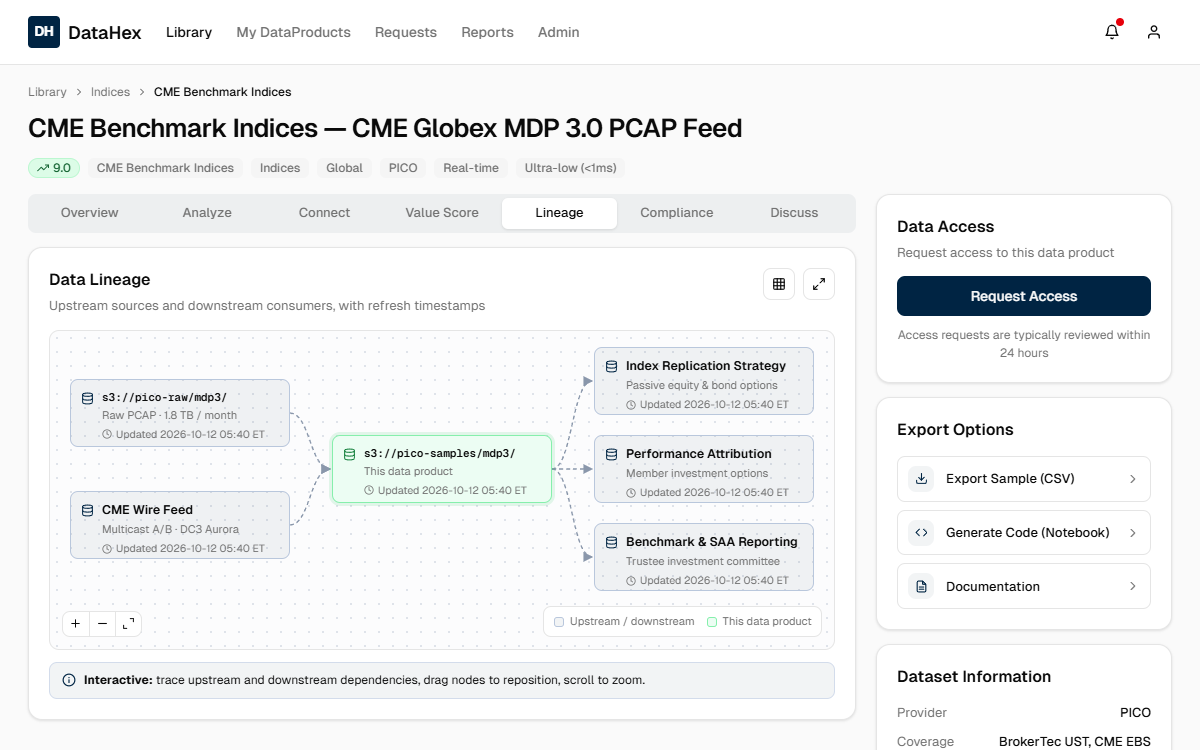
A living knowledge graph connects every asset, column, owner, glossary term, classification, quality signal, lineage edge, policy and contract. Relationships are first-class: not just that a data set exists, but what it means, where it came from, who owns it, how it is used, and whether it can be trusted.
01Meaning and classification
- Business-first name, description and glossary terms, so every team uses the same definition
- Classification against your taxonomy and sensitivity levels: public, internal, confidential, restricted
- Custom taxonomy per organization, with hierarchies such as Region → Site → Asset
02Origin and lineage
- Automated table, column, pipeline, dashboard and ML-model lineage from SQL, dbt, Airflow and Spark, with OpenLineage ingestion
- Impact analysis: change a source and see every downstream report, model and process it touches
03Quality and data contracts
- Metrics for completeness, freshness, schema stability and primary-key uniqueness, with anomaly flags
- Scheduled freshness, volume and integrity tests with alerting
- A data contract on every product: expected schema, required semantics, assigned quality tests and execution history
04Ownership, access and usage
- Named owners and stewards on every product
- Who has access, under which role, and who approved it
- Most-used and under-used assets, and failed searches that signal unmet demand
Across industries
Data DNA, quality and context drives confidence in decisions
RoZetta has built data platforms for energy, utilities, telecoms, payments, property and research, for workflow optimization, anomaly detection and total quality systems. In each case the value depended on knowing what the data was, where it came from and whether it could be trusted.

Monitoring and operations optimization
Over 200,000 sensors streaming metrics from operational plants 24x7, supporting thousands of data science workloads. RoZetta delivered a new data lake architecture with access APIs to rapidly onboard new use cases.
Why DNA matters: Operational data is only reusable when each sensor stream is described, owned and access-controlled.

Infrastructure monitoring and leakage detection
An anomaly detection model identifying potential leaks from pressure and flow changes, built end to end in six weeks. The proof of concept surfaced time-stamping issues in the existing sensor network.
Why DNA matters: Knowing the lineage and quality of each sensor feed is what makes a detection model trustworthy.

Detecting and mitigating fraud in messaging
Real-time identification of anomalous messages and senders, with enriched data streamed to live dashboards and returned as flags through an API.
Why DNA matters: Message, sender and behavioral data governed as products supports compliance and customer trust.
Monitoring across payments and communications
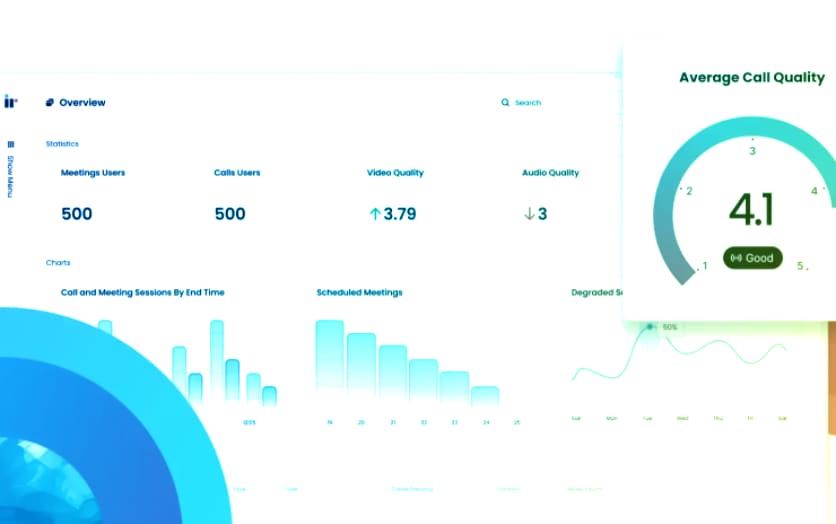
Near-real-time monitoring across payment hubs and contact centers, scaling to 300,000 payment transactions per second at peak with data recency under 30 seconds.
Why DNA matters: At that volume, a total quality system depends on knowing which data is fit for which purpose.
Residential refinance index from behavioral data
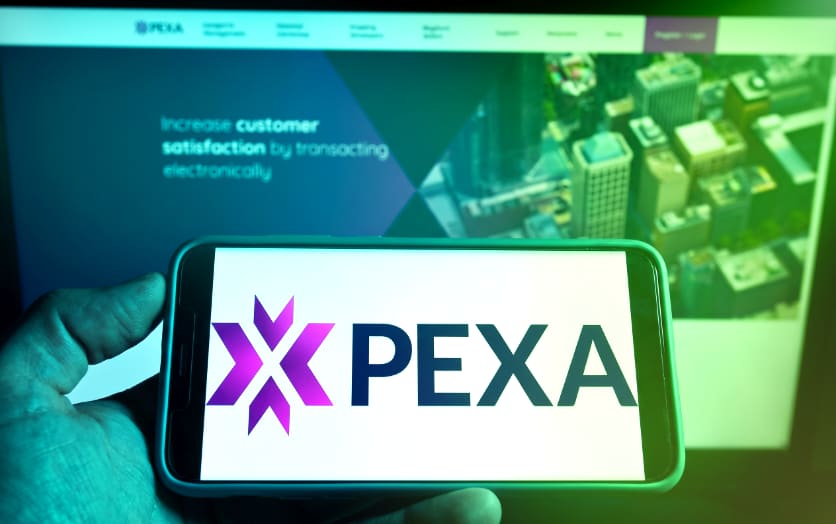
Behavioral data turned into a refinance index at every level of geography, with monthly updates delivered to subscribers through the PEXA portal.
Why DNA matters: Corporate data became a licensable benchmark because its origin and definitions were clear.

NLP entity tagging across 23,000 transcripts
Over 2.9 million entity mentions mapped, lifting discoverability of entity mentions to 98.3% from 37.4%.
Why DNA matters: Tagging unstructured content to reference data turned transcripts into discoverable, linkable data.
Ownership and access
Clear accountability, controlled access
Products are organized into governed business domains, by function, site or business unit, each with clear ownership. Policies are defined once and enforced across the catalog, data stores and agentic access.
Named owners
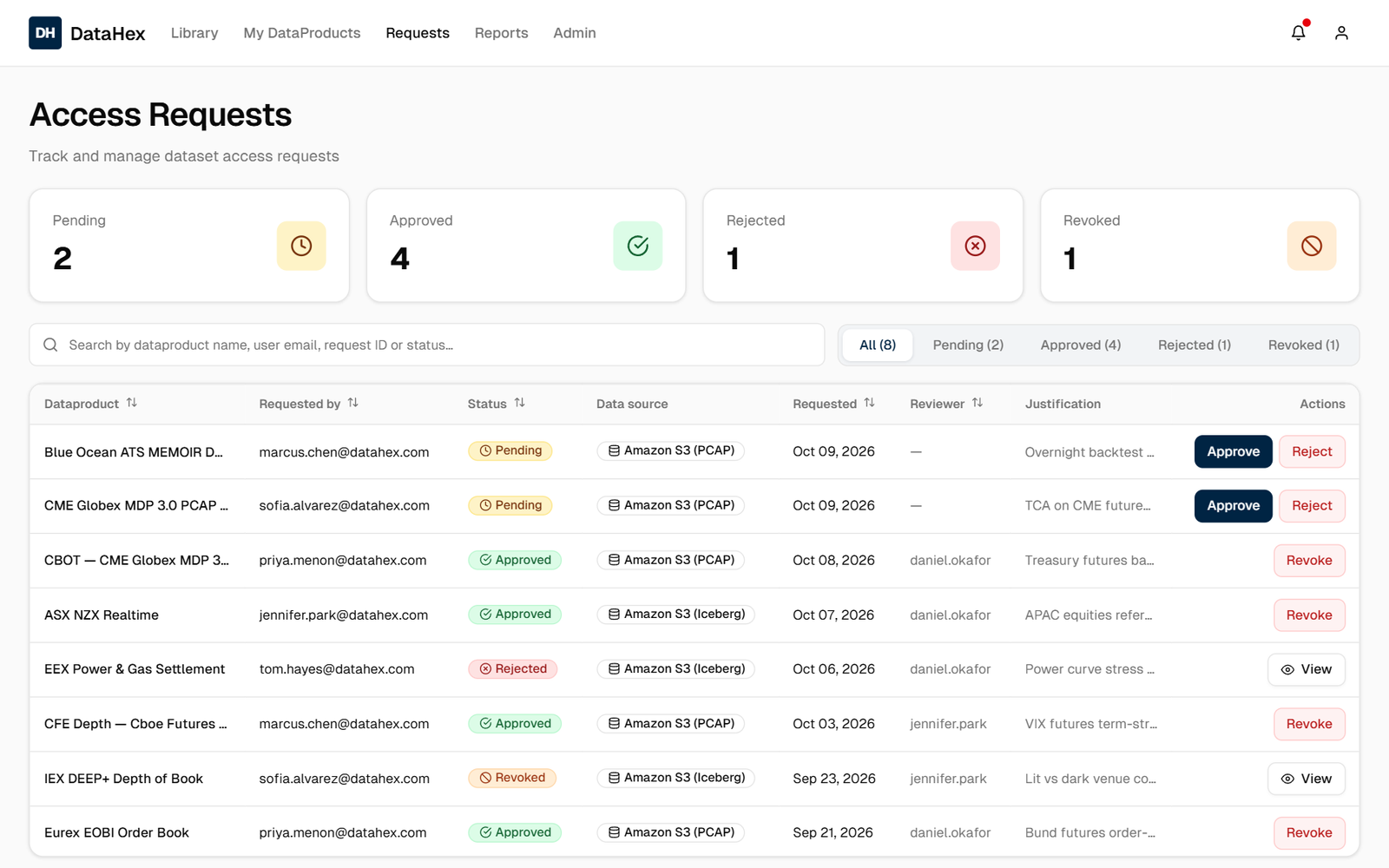
Each product has explicit owners on its detail page. Customizable roles, such as Consumer, Steward and Admin, are scoped per organization.
Stewards approve access
Stewards approve requests for the products they own; admins hold platform-wide override, so approvals do not bottleneck.
Fine-grained controls
Access scoped to product, table, partition and row level, enforced for people and AI agents alike.
Masking and classification
Policy-driven masking protects sensitive fields, and classification travels through lineage and delivery.
Self-service requests
Entitlement-based self-service replaces ticket queues, so data teams spend less time brokering access.
Complete audit trail
Every user operation and data-access event recorded, with compliance reporting on the same substrate.
Prepare for AI
Give your AI agents governed, well-described data
DataHex is MCP-native. Every agent inherits the same entitlements, lineage, classification, policy and audit as a human user, so adopting AI does not widen the company’s control surface.
Analyst Agent
Plain-language questions return governed SQL, answers, charts and dashboards, within the user’s entitlements.
Governance Agent
Drafts data products from a connection or sample file for stewards to review. What can take a day per data set takes minutes.
Compliance Agent
Reads license agreements and data contracts, extracting entitlement, redistribution and retention terms.
Open standard
Any MCP-compatible client reaches the Library through the same interface, with no proprietary SDK.
Long-term competitive advantage
Institutional knowledge that compounds
Definitions, decisions, corrections and questions accumulate in the knowledge graph as reusable institutional knowledge. The longer the Library runs, the more the company knows about its own data.
Knowledge stays
Context compounds over time instead of leaving with the people who held it.
Faster new initiatives
New teams, use cases and AI projects start from a governed, documented inventory.
New revenue from data
Well-defined data products can become licensable products, benchmarks and indices, as PEXA’s refinance index shows.
No lock-in
Open table formats, YAML-portable taxonomy and full metadata APIs keep your data and configuration yours.
Deployment
Live in weeks, in the environment you choose
Multi-tenant or dedicated, on AWS or Azure, in customer-managed or RoZetta-managed accounts. Storage stays in the region you already operate in.
- 01
Connect
130+ out-of-the-box connectors across databases, warehouses, lakes, BI tools, pipelines, ML platforms, messaging and storage.
- 02
Onboard
The Governance Agent drafts each data product for steward review, and bulk onboarding stands up dozens from curated specs.
- 03
Govern
Owners, access policies, quality tests and data contracts applied by domain.
- 04
Expand
Add domains, AI agents and use cases at your own pace, with no data copy.

See how your company’s data can be governed, owned and AI-ready
A walkthrough tailored to your use case, industry and AI plans.